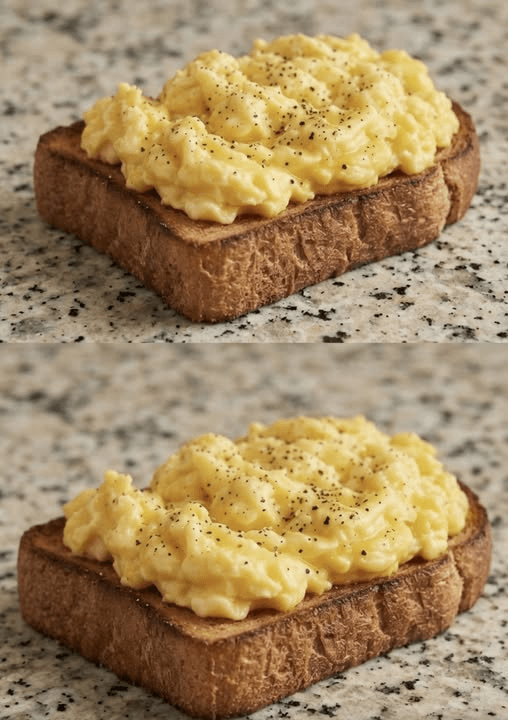
he Ultimate Fluffy & Creamy Scrambled Eggs (The One-Hack Method)
Why This Recipe Is Different
Most people overcook scrambled eggs. That’s the entire problem.
They cook them too hot, stir them too fast, season them wrong, or treat them like an afterthought. This method flips that mindset. Instead of cooking eggs aggressively, you gently coax them into curds, letting heat and time do the work.
The “hack” isn’t a gadget or a fancy ingredient — it’s temperature control + patience + timing.
Once you learn this, you’ll never go back.
Ingredients (Serves 2–3)
Eggs
-
6 large eggs (fresh if possible)
Fat (choose ONE)
-
2 tablespoons unsalted butter
or -
1½ tablespoons heavy cream + 1 tablespoon butter
Seasoning
-
Salt (added at the right time — this matters)
-
Freshly ground black pepper
Optional Add-Ins (use sparingly)
-
1 tablespoon crème fraîche, sour cream, or cream cheese
-
Chives or parsley, finely chopped
For Serving
-
Thick toast (sourdough, brioche, or country loaf)
Equipment (Also Important)
-
Nonstick pan (small to medium size)
-
Silicone spatula (not a whisk, not a spoon)
-
Low heat source
-
Bowl for eggs
Step 1: Crack & Mix the Eggs (But Don’t Overdo It)
Crack the eggs into a bowl.
Using a fork or whisk, gently beat them just until the yolks and whites are combined. You’re not trying to whip air into them — just unify them.
👉 Do NOT add salt yet.
This is part of the hack. Salting too early changes how egg proteins set and can make them watery instead of creamy.
Stop mixing once the eggs look uniform. Set aside.
Step 2: Start Cold (Yes, Cold)
Place your nonstick pan on the stove before turning on the heat.
Add:
-
The butter
-
The eggs
At the same time.
This is crucial. Starting cold allows the eggs to heat slowly and evenly, preventing rubbery curds.
Turn the heat to LOW. Not medium-low. LOW.
Step 3: Slow Cooking = Creamy Eggs
Now comes the patience part.
Using your silicone spatula:
-
Stir slowly in gentle sweeping motions
-
Scrape the bottom and sides of the pan
-
Push eggs from the outside toward the center
You’re not scrambling aggressively. You’re folding and guiding.
At first, nothing happens. That’s good.
After 1–2 minutes, you’ll notice the eggs begin to thicken slightly. Keep stirring slowly.
After 3–4 minutes, soft curds start forming.
👉 If steam appears or eggs sizzle, your heat is too high. Take the pan off the heat for 20 seconds, then continue.
Step 4: The Secret Creaminess Moment
When the eggs are about 80% set — still glossy, slightly loose, and custardy — remove the pan from the heat.
This is where most people fail by waiting too long.
Residual heat will finish the cooking.
Now add:
-
A pinch of salt
-
Optional crème fraîche or cream cheese (this instantly stops overcooking and adds richness)
Fold gently. The eggs should look soft, thick, and luxurious, not dry.
Step 5: Final Seasoning & Texture Check
Taste the eggs.
Add:
-
More salt if needed
-
Freshly ground black pepper
The texture should be:
-
Soft
-
Creamy
-
Slightly glossy
-
Holding shape but not stiff
If they look too loose, give them 10 seconds back on very low heat, stirring gently.
Step 6: Serve Immediately (Eggs Wait for No One)
Scrambled eggs continue cooking even after leaving the pan, so serve them right away.
Spoon generously onto warm toast.
Optional finishing touches:
-
Chopped chives
-
Extra black pepper
-
A tiny knob of butter melting on top
Why This Works (The Science, Simply)
Eggs are mostly protein and water. When heated too quickly:
-
Proteins tighten
-
Water squeezes out
-
Eggs turn dry and rubbery
Low heat + constant gentle movement:
-
Allows proteins to set slowly
-
Traps moisture
-
Creates small, tender curds
Adding dairy at the end:
-
Cools the eggs
-
Prevents overcooking
-
Boosts creaminess
Common Mistakes to Avoid
❌ High heat
❌ Walking away
❌ Over-stirring like a maniac
❌ Waiting until eggs “look done”
❌ Salting too early
Variations the Kids Usually Love
Cheesy Scrambled Eggs
-
Add ¼ cup shredded cheddar or mozzarella after removing from heat
Extra Creamy Breakfast Eggs
-
Replace butter with heavy cream + butter combo
Protein Boost
-
Fold in cottage cheese at the end (sounds weird, tastes amazing)
Storage & Reheating (If You Must)
Scrambled eggs are best fresh, but if needed:
-
Store airtight up to 24 hours
-
Reheat gently on low heat with a splash of milk
-
Never microwave on high — it ruins the texture
Final Thought
This isn’t just a recipe — it’s a technique. Once you master it, you’ll make perfect scrambled eggs:
-
For kids
-
For brunch
-
For toast
-
For life
And yes… once people taste them, they will ask you to make them again tomorrow 😄🥚